Railroad Records

A Birthday, a Ferry, and an Unexpected Discovery

An obscure railroad publication reveals an important date in the Binghamton's early history — and a coincidence that makes the discovery unexpectedly personal.

When you're researching the history of a vessel built in 1905, you quickly discover that some of the simplest questions are surprisingly difficult to answer.

Take dates, for example.

I knew the Binghamton had been built in 1905 for the Delaware, Lackawanna & Western Railroad. But establishing exactly when she arrived in Hoboken, when she entered service, and where she began her working life proved considerably more challenging.

Newspaper archives provided pieces of the story. Historical accounts offered others. But finding precise dates, especially ones supported by contemporary railroad records, was another matter entirely.

And then, while looking at the website of a North Jersey historical society, I came across a book title called The Romance of the Hoboken Ferry.

I immediately started scouring the internet to learn more about it, and hopefully find a copy I could buy. I learned that the book was published in 1931 by the Delaware, Lackawanna & Western Railroad and it was, let's just say, hardly a bestseller. It was a specialized publication produced by the railroad, primarily for people connected with its operations.

Nearly a century later, tracking down copies is difficult to say the least.

After looking at all the usual places and finding nothing, I got lucky. I found exactly one copy of it on AbeBooks, and I happily hit the "ORDER" button quickly.
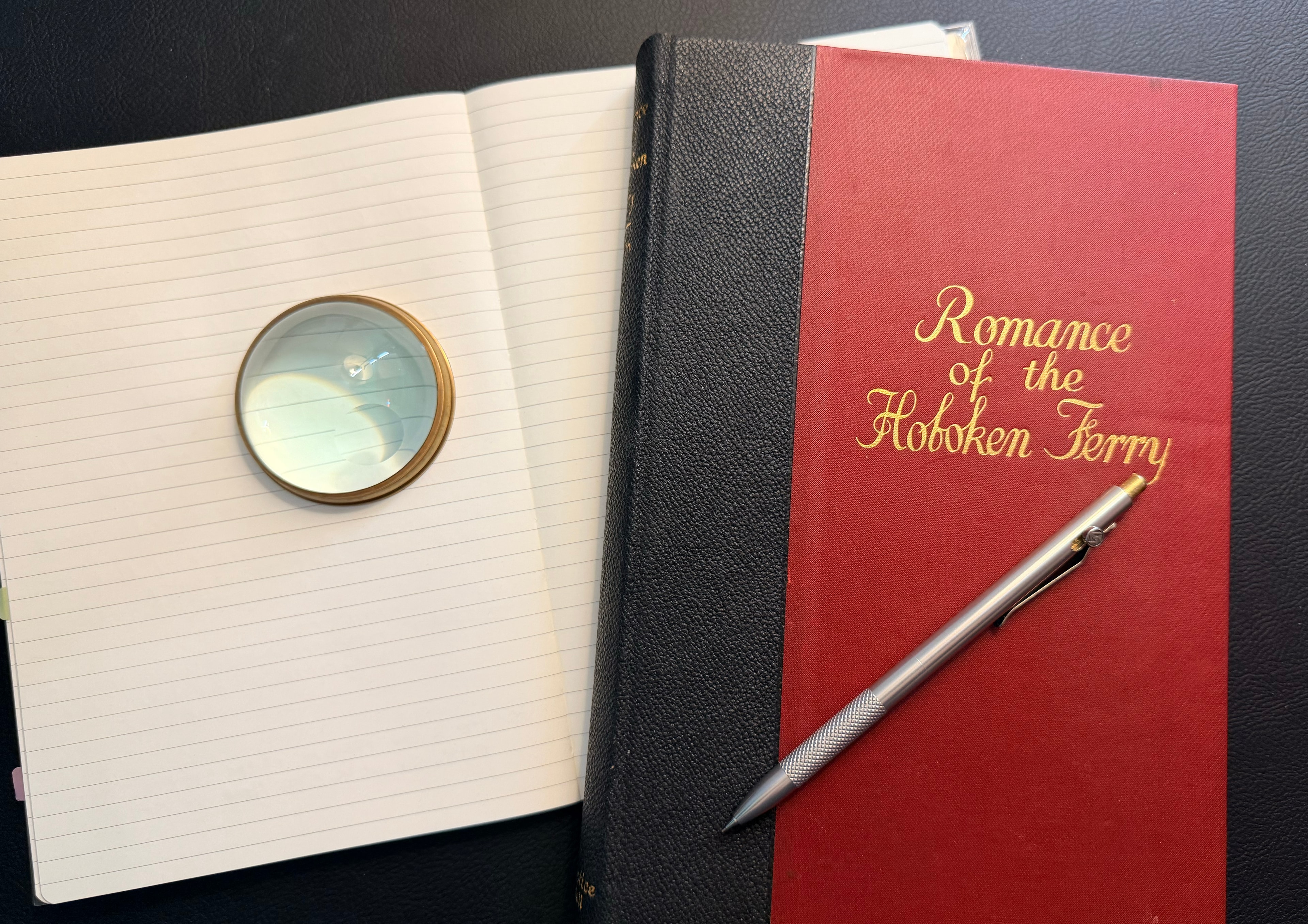
The Romance of the Hoboken Ferry book with a Nantucket paperweight and notebook
A pristine copy of this wonderful book. On the left, my favorite paperweight that I got in Nantucket, made from glass and metal from a scrapped ship.

Then it dawned on me that I knew very little about what was actually inside this book. Would it contain anything useful about the Binghamton? Would it answer any of my questions? Or would I end up with an interesting but largely irrelevant addition to my growing collection of historical material?

When the book arrived, I discovered something unexpected before I'd even opened it.

The bookseller had included a handwritten note asking how I had known the book existed in the first place. Apparently, even HE was surprised that someone had come looking for it.

I had to laugh. At that point, I was beginning to wonder the same thing myself.

As I began reading, I realized I'd stumbled onto something considerably more valuable than I'd anticipated.

The book contained photographs, historical details, information about the railroad's ferry operations, and even the cost of constructing the Binghamton.

But one particular detail immediately caught my attention.

According to the railroad's own account, the Binghamton was received at its Fourteenth Street shops in Hoboken on March 26, 1905.

That was the date I'd been trying to establish. It was also a date that is very familiar to me.

March 26 is my birthday. Not 1905, obviously. I arrived 68 years later. But of all the dates in the calendar, the Binghamton had arrived in Hoboken on the very same day I would eventually be born.

Now, I'm not suggesting there was anything mystical about this coincidence. The Binghamton and I simply happen to share a date on the calendar.

But after spending so much time trying to piece together the vessel's history, finding that particular detail in an obscure book I'd purchased almost on a whim was a delightful surprise.

It was also a reminder of why I enjoy historical research so much. You begin with a question. You follow one lead, then another. Sometimes you spend hours searching and come away with absolutely nothing. Other times, something you weren't even looking for turns out to be the most interesting discovery of the day.

In this case, a nearly century-old railroad publication answered several important questions about the Binghamton's earliest days, and it gave me a birthday connection I certainly hadn't expected.
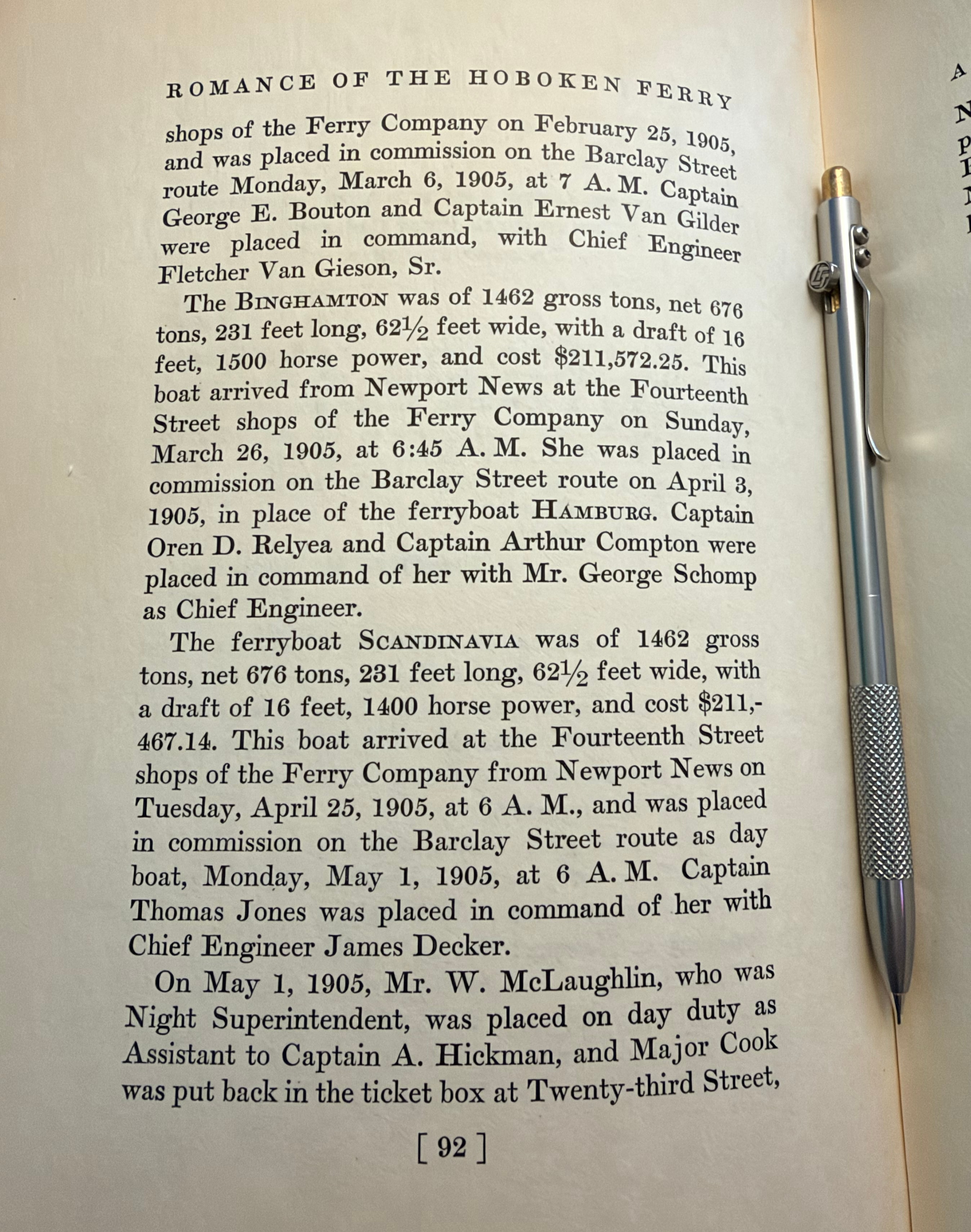
Page from The Romance of the Hoboken Ferry showing the Binghamton's arrival date
There it was, the information I was looking for.

The book had more surprises waiting for me, too. Among its pages were several references to Captain Oren D. Relyea, who was the Binghamton's captain on her very first trip across the Hudson River.

At the time, I knew very little about him. Even locating a single photograph had proved difficult.

But those references would lead me to discover the story of an experienced mariner who had devoted years of his life to the railroad, earning a reputation as a steady, dependable captain. He commanded the Binghamton during part of her working life, navigating the busy waters of the Hudson River with little of the drama that would come to define the vessel's later years.
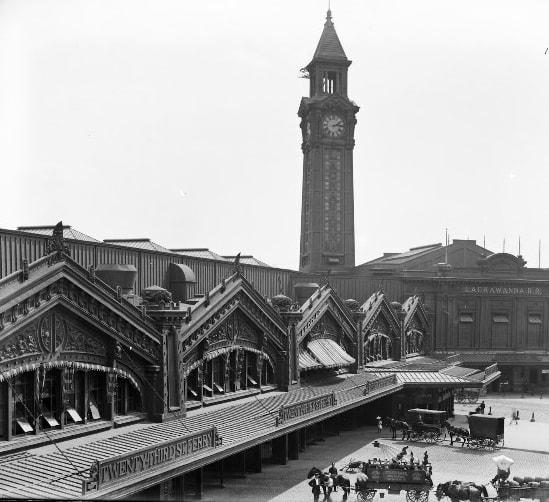
The Lackawanna Ferry Terminal in 1909, with its iconic clock tower
The Lackawanna Ferry Terminal, 1909.

That's one of the fascinating things about researching history: sometimes the answer to one question becomes the beginning of an entirely different story.

Continue exploring: Finding Captain Relyea
Historical Research

Finding Captain Relyea

A name in an old railroad publication leads to a search through newspaper archives, family photographs, and the remarkable records of a man who spent more than four decades working on the Hudson River.

When you spend enough time researching an old ferryboat, you eventually realize that its history isn't just about the vessel.

It's about the people who built it, operated it, maintained it, and spent their working lives aboard it. People whose names may appear in official records but whose individual stories have largely disappeared with time.

Captain Oren D. Relyea was one of those people.

He was the pilot who guided the Binghamton out of Hoboken on her first crossing on April 3, 1905. His name appeared several times in The Romance of the Hoboken Ferry, a railroad publication from 1931 that I'd acquired while researching the vessel's earliest years.

Naturally, I wanted to know more about him. That turned out to be considerably more difficult than I expected.

Finding references to Captain Relyea wasn't impossible. Finding much of anything about him was another story.

I searched historical newspapers, railroad publications, and whatever other records I could locate. His name appeared occasionally in accounts of ferry operations, and I found numerous society page mentions from the early 1950s that primarily concerned his wife and what vacation she had taken.

But I couldn't find a photograph of him anywhere. For someone who had spent decades working for a major railroad and navigating one of the busiest waterways in the country, he seemed remarkably difficult to track down.

Eventually, I decided to try Ancestry.com. And there he was.

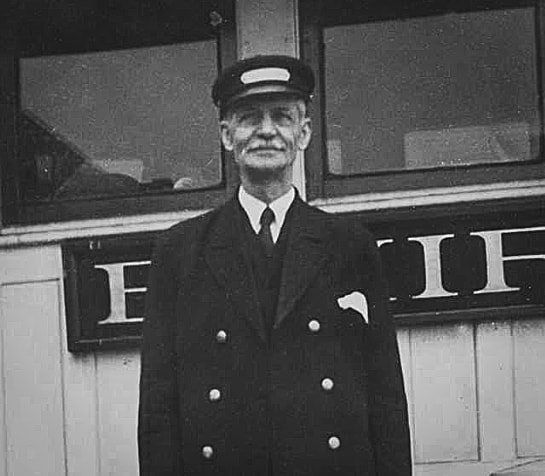
A relative had uploaded a photograph of Captain Relyea to a public family tree. After all that searching, I finally had a face to put with the name.

Captain Oren D. Relyea standing in front of the pilot house of the Elmira
Captain Oren D. Relyea, the Binghamton's first captain. Shown here in front of the pilot house of the Elmira, one of the Binghamton's sister ships.

But the discovery didn't end there.

Using that photograph, I conducted a reverse-image search and located a matching image in a national archival repository. Without the photograph his relative had shared, I might never have found it. It was a wonderful reminder that historical discoveries don't always begin in a formal archive. Sometimes the most important clue comes from someone preserving a piece of their own family's history.

As I continued researching Captain Relyea, a much more complete picture of his life began to emerge.

Born in Glasco, New York, on December 9, 1870, he came from a family with deep connections to the Hudson River.

His father, Captain Hiram D. Relyea, built iceboats, including one called the Avalanche, which reportedly earned a reputation as one of the fastest in the world. His older brother, William, became a captain on the Hudson River Day Line.

Oren joined the Delaware, Lackawanna & Western Railroad's marine department in February 1899 as a quartermaster. By April 1901, he'd become a pilot.

Four years later, he was at the wheel when the Binghamton made her first crossing.

Navigating the Hudson in those days was no small responsibility. Ferries shared the water with tugboats, barges, ocean liners, and countless other vessels. Bringing a large ferry safely into a crowded slip required considerable skill and experience.

And even experienced captains occasionally found themselves in difficult situations.

In July 1906, Relyea was involved in a collision between the Lackawanna ferry Bergen and a vessel called the Perseus. Federal steamboat inspectors suspended his pilot's license for 100 days.

The railroad, however, believed he had been treated unfairly. What followed was a prolonged dispute involving railroad officials, federal inspectors, and allegations concerning the pilots' union. Relyea ultimately received a second suspension over accusations that he'd continued performing pilot duties while his license was suspended.

It was a complicated episode, and one that revealed just how contentious the business of operating ferries could become.

But the railroad kept him, and Relyea went on to enjoy a long career. He retired on December 31, 1940, at the age of seventy, after nearly forty-two years with the Lackawanna Railroad.

One of my favorite discoveries came from Relyea's railroad retirement records.

When he applied for his pension in 1940, the government required proof of his age. There was just one problem. He didn't have a birth certificate.

He was able to prove his age using a family Bible. I go into more detail about this in the book, so I don't want to spoil it for you, but let's just say…it made me smile, and that little detail made him seem remarkably human.

Relyea died at his home in Hoboken on June 19, 1942, just eighteen months after retiring.

His career wasn't entirely without controversy, but it was a long one, filled with the responsibilities and routines of a profession that most passengers rarely thought about.

And that's what made finding him so rewarding. Before the Binghamton became a restaurant in the 1970s, she was a working ferry, carrying people across the Hudson, day after day.

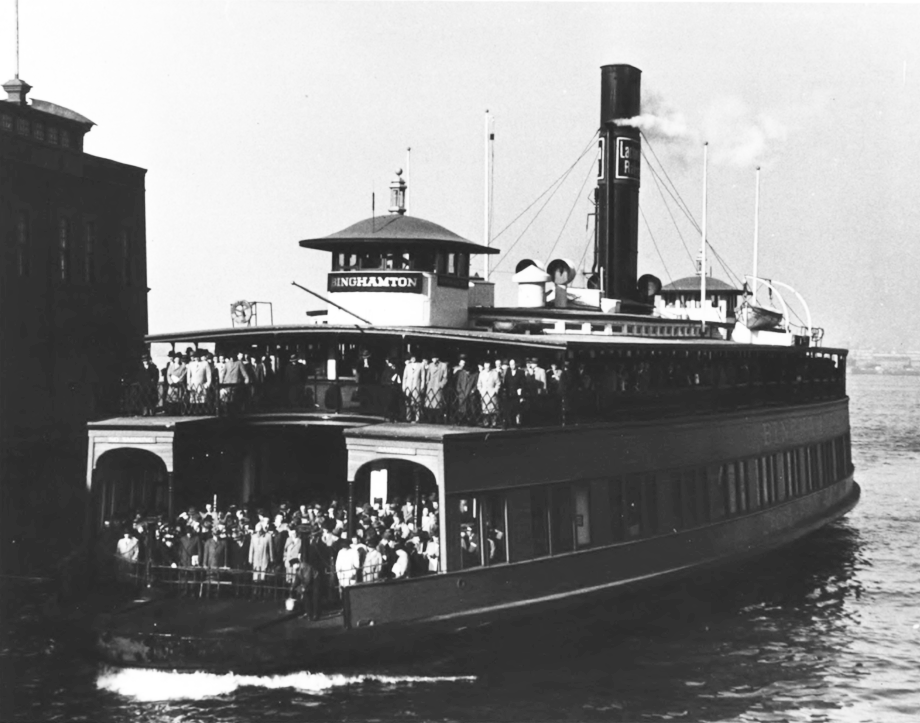
The Binghamton ferry arriving at Barclay Street in the 1930s
The Binghamton in the 1930s, arriving at Barclay Street.

Men like Captain Relyea made those crossings possible.

What began as a search for a photograph became something much more interesting: an opportunity to reconstruct pieces of a life that might otherwise have remained little more than a name in an old railroad book.

Sometimes historical research uncovers scandals, mysteries, and extraordinary events.

And sometimes the most satisfying discovery is simply finding the person behind the name.

Explore another discovery: A Birthday, a Ferry, and an Unexpected Discovery

The Edgewater Years

The Mystery Bungalow

For years, a small brown building on the Binghamton's waterfront property raised questions that proved surprisingly difficult to answer. It took a devastating hurricane to finally blow the doors open — literally.

Of all the things I expected to investigate while researching the Binghamton, a small brown building wasn't particularly high on the list.

But while reconstructing the events surrounding the September 17, 1997, kidnapping of the ferry's owner, Nelson Gross, I came across a detail that sent me looking for one.

Gross maintained an office on the waterfront property, separate from the ferryboat itself. It was an important location in the story because it was the first place his kidnappers took him after abducting him that morning.

Naturally, I wanted to figure out exactly where that office had been.

One of the clues came from a book written by Gross's daughter, Dinah Lenney, who described her father's office as being in a brown bungalow on the property beside the ferry.

I'd visited the Binghamton numerous times over the years, but I couldn't recall ever seeing anything that fit that description. So I started examining photographs of the property, looking for a building I might have overlooked.

And then I found it. In a photograph I'd taken myself.

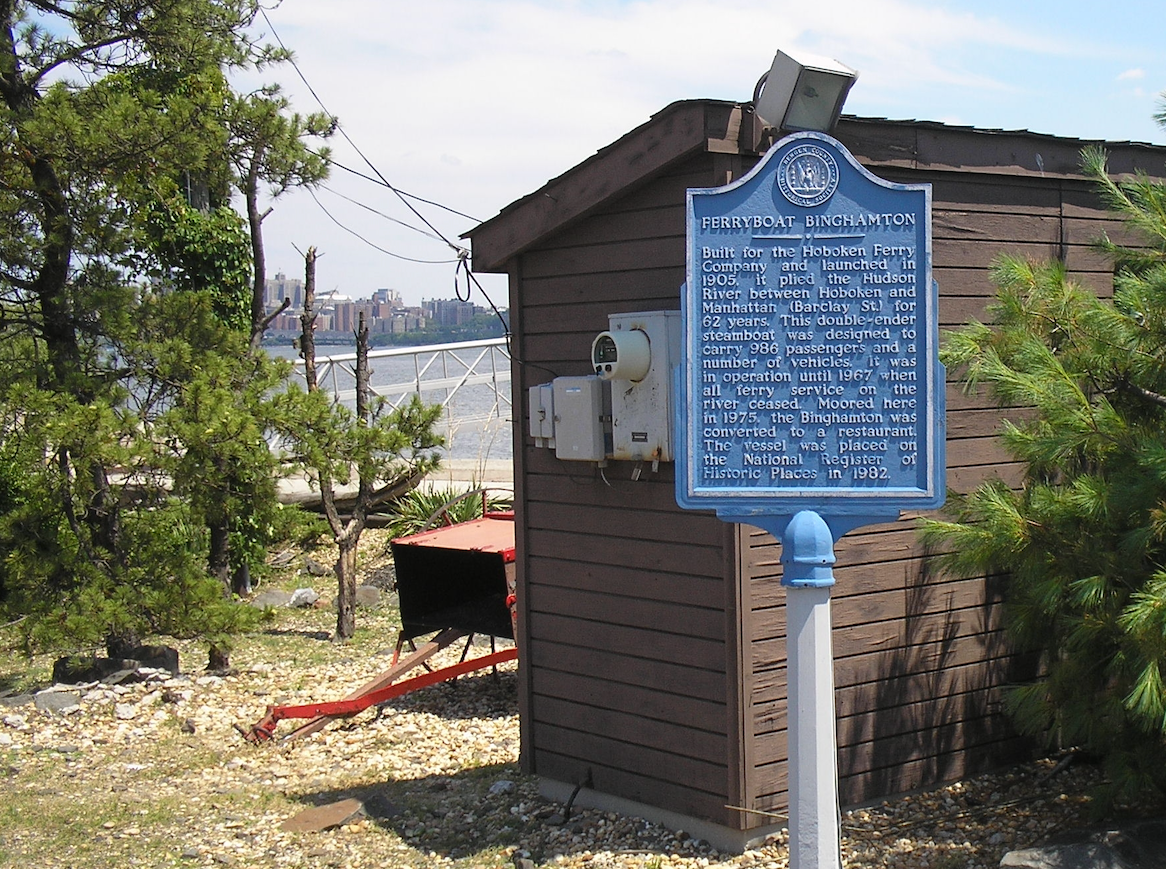
The brown bungalow beside the Binghamton's gangway entrance, with the National Register of Historic Places sign in the foreground
The brown bungalow to the left of the entrance to the gangway. Also shown is the Binghamton's National Register of Historic Places sign.

In almost every photo of the Binghamton's gangway entrance taken before 2016, there was a curious little brown structure standing near the covered gangway leading aboard the ferry.

It wasn't especially attractive or architecturally interesting. In fact, it was exactly the sort of building you might walk past without giving it a second thought.

Which, apparently, was precisely what I'd done – like some kind of historical research equivalent of looking for your glasses while they're sitting on top of your head.

I started looking through a number of photos of the Binghamton from different eras. That same brown structure was in many of them, dating back to the early 1990s. After finding a photo from 1982 where it did not appear, I started narrowing the focus to dates only in that range to try to find an answer.

The more photographs I examined, the more curious I became. Was this little building the office she mentioned in the book? And if that was not the office, then…what was it?

And as anyone who has ever disappeared down a historical research rabbit hole can tell you, sometimes the smallest questions turn out to be surprisingly difficult to answer.

There were clues, and there were possibilities. But nothing that provided a completely satisfactory answer.

And then I came across photographs taken after Superstorm Sandy struck New Jersey in October 2012.

Sandy caused enormous destruction along the Hudson River waterfront, and it hit the Binghamton especially hard. Having already been sitting abandoned and neglected for several years – and suffering damage by Hurricane Irene the year before – the damage from Sandy was more than the old ferryboat could take. Anybody looking at her, even from a distance now, could tell that she was approaching the end.

Some of the photographs were truly sad to see. Pieces of her wood trim and decking blew onto shore, ripped from where they had been for decades by high winds. There were chairs, a section of flooring, and other debris everywhere.

Then, among the photographs documenting the aftermath, I saw it. The little brown building. It was still there.

Only now, it wasn't quite as mysterious.

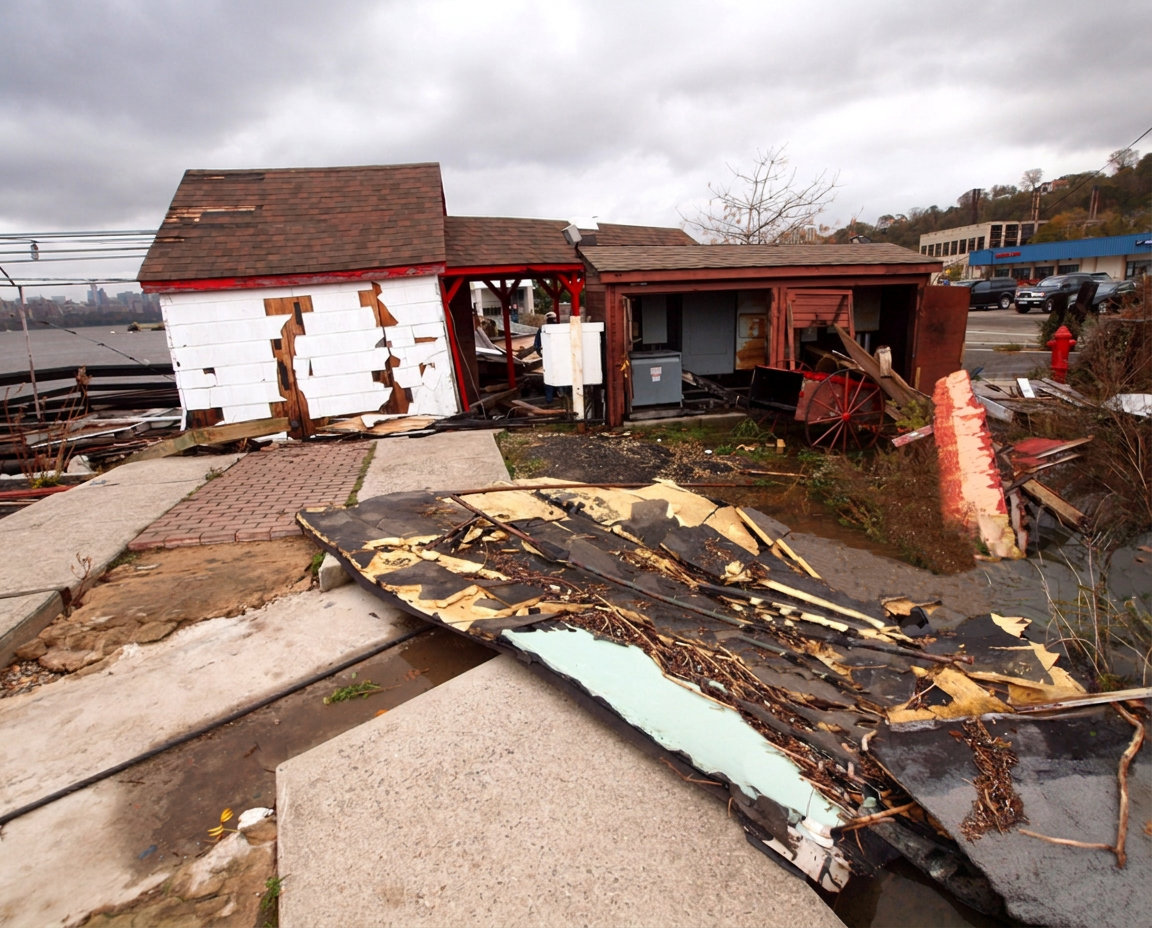
Storm damage at the Binghamton waterfront after Superstorm Sandy, with the brown bungalow's doors blown open
Superstorm Sandy's 90+ MPH winds ripped the doors open on the small brown structure, revealing the inside contents.

The storm had blown open its doors. One panel had been torn completely from its hinges, exposing the interior.

And suddenly, there was the answer to a question I'd spent so much time trying to resolve.

Inside were electrical meters, panels, and other utility equipment. The mysterious little bungalow was, at least by that point in its history, serving as a utility building, and it looked like that had been its function for a long time.

The discovery didn't solve the mystery of where Nelson Gross's office had been located. That would require further research and conversations with people who had been there at the time.

But it did finally answer one of the strangest little questions I'd encountered during my investigation: What was inside that mysterious brown building?

Sometimes historical mysteries are solved by uncovering forgotten documents or following clues buried in old newspaper archives.

And sometimes Mother Nature quite literally blows the doors off.

Explore another discovery: A Birthday, a Ferry, and an Unexpected Discovery